Hi Marley
Hi Marley Prototype
Design Technologist · Design Systems
Hi Marley is the messaging layer for insurance claims: carriers talk to policyholders the way people actually text, instead of burying them in portals and phone trees. As lead designer I am accountable for product design, vision, and execution across all product teams for a SaaS platform used by 100+ carriers and about 30,000 people.
- 100+
Insurance carriers on the platform
- 50%
Design-to-dev rework
- Four component libraries consolidated into one Figma + React system
The org problem
Claims communication looks simple from the outside. Inside the company it was four design languages, duplicated patterns, and a handoff model that made every AI or messaging feature pay a tax in rework. Product teams could not share components, engineering reinterpreted Figma on every surface, and the gap between “designed” and “shipped” kept widening as AI entered the roadmap.
The job was not another feature set. It was to change how design and engineering decide, prototype, and ship, so carrier-facing work stayed coherent while the product absorbed summarization, writing assistance, fraud and risk signals, and image analysis.
Role vs. the team
I own product design vision and execution across product teams: the bar for craft, the shared system they build on, and the fidelity model that decides when we sketch in Figma, prove in React, or ship production code. PMs and engineers partner on scope and delivery; I am accountable for the experience system those teams share.
That includes consolidating four component libraries into one Figma and React architecture, migrating production surfaces onto it, and bringing AI coding agents into the development lifecycle so design can validate in working software instead of waiting on traditional handoffs.
One system, chosen by intent
We collapsed four libraries into a centralized design system (tokens, accessible React components, and Figma counterparts), then migrated production code to the shared architecture. Storybook became the engineering source of truth; designs reference the same parts engineers ship.
Alongside the system I introduced a three-tier fidelity model: production code when the interaction is the product, interactive React prototypes when we need to prove flow and trust, and Figma overlays when the question is layout or brand. Teams pick the medium by intent instead of defaulting to high-fidelity mockups for every problem.
Tradeoff: short-term migration cost and discipline on contribution rules. Payoff: feature teams compose from shared parts, and design-to-dev rework dropped about 50% as specs stopped being reinterpreted from scratch.
AI in the product and the practice
On the product side I designed and helped ship AI-powered experiences and prompt workflows for claims submission, writing assistance, claim summarization, fraud detection, risk analysis, and image analysis. The hard design problem was trust: keep the adjuster in control, make machine output inspectable and editable, and never treat a suggestion as an authority.
On the practice side, agentic coding workflows moved into how we discover and validate. Prototypes can reach production-shaped React faster, which cuts the classic design-to-engineering handoff and lets us kill weak ideas before they harden into tickets.
What changed
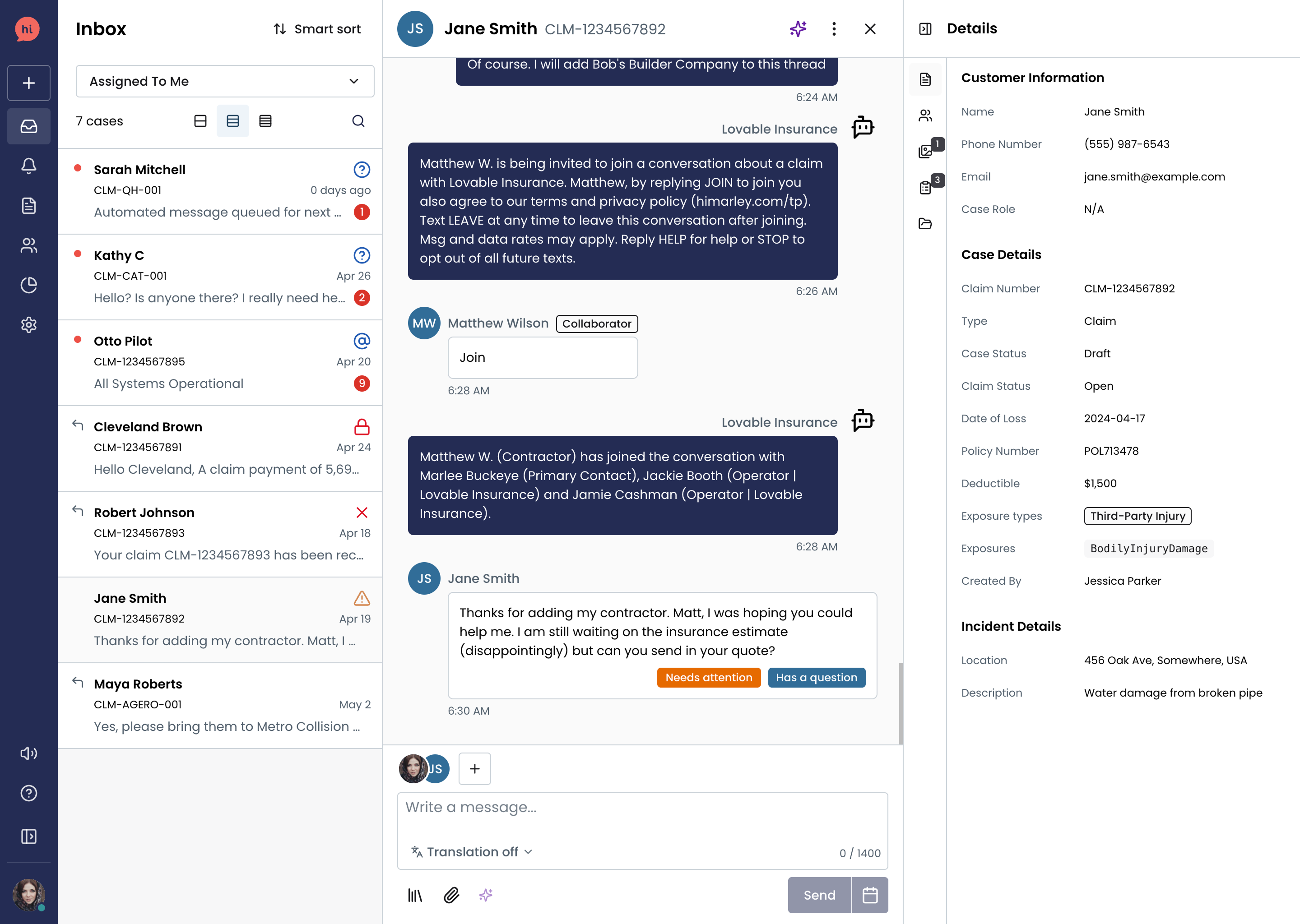
Carriers and adjusters get one coherent messaging product instead of a patchwork of libraries. Teams ship AI-assisted claims workflows on a shared system, with a fidelity model that matches the question being asked. The live inbox prototype reflects the redesigned application patterns; deeper cuts on system, AI, outreach, privacy, and mobile sit in the linked chapters.
Deeper cuts
- Hi Marley Design System: Production React components, tokens, and patterns that scale across the product.
- Brand Agent: Brand-aligned experiences and tooling for a consistent customer-facing voice.
- FNAL AI: AI-assisted workflows and interfaces for carrier teams.
- Outreach: Proactive messaging flows for claims and service teams.
- Image and text redaction: Privacy-safe handling of sensitive content in communications.
- Mobile: Mobile experiences for policyholders and adjusters on the move.
- Application Redesign: End-to-end application UX modernization across core journeys.